Understanding Radioactive Decay and Visual Erosion
Imagine a beautiful, hand-written letter that has sat in the rain for decades. The ink bleeds, the paper softens, and eventually, the words dissolve into a messy, drippy goo. This visual transformation is striking because it tells a story of time passing and matter changing. In the scientific world, this concept mirrors radioactive decay, a fundamental process where unstable atoms lose energy to become more stable. While we cannot see individual atoms turning into goo with our naked eyes, the principle remains the same: things change over time, breaking down from a complex state into something simpler.
For creators, educators, and curious minds, understanding this natural phenomenon offers more than just physics knowledge. It provides a powerful metaphor for creativity, business growth, and the inevitable passage of time. Whether you are designing a digital asset that mimics weathering or simply trying to grasp how the universe works, grasping the mechanics of decay helps us appreciate the value of what exists right now.
The Science Behind the Breakdown
At its core, radioactive decay is nature's way of balancing the scales. Certain atoms have too much energy or an unstable mix of protons and neutrons. To fix this imbalance, they release particles or energy in a process called radiation. Over time, the original atom transforms into a different element or a stable version of itself. This isn't a sudden explosion; it is a gradual, predictable shift.
Think of it like a melting ice sculpture. As the sun hits it, the solid structure slowly loses its shape, dripping down into puddles. Similarly, a radioactive substance doesn't disappear instantly; it decays at a specific rate known as its half-life. This means that after a set period, exactly half of the original material will have transformed. This predictability is what makes it so useful and fascinating.
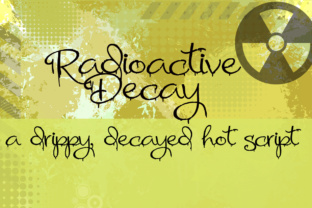
The phrase "This pretty hand-written script has been decayed away and is drippy goo" captures the aesthetic result of this physical process. Just as the ink spreads and the paper disintegrates, radioactive materials emit radiation until they reach a stable state. The transition from order to chaos, from clear text to indistinguishable sludge, is a perfect visual representation of entropy increasing in a system.
Why Does This Matter to You?
You might wonder why someone interested in marketing, education, or small business needs to know about atomic breakdown. The answer lies in application and inspiration. Professionals often look for unique ways to communicate complex ideas or to create memorable visual experiences. Understanding decay allows you to:
- Create compelling narratives: Use the concept of decay to tell stories about history, loss, or transformation in your content.
- Design authentic visuals: Artists and designers use decay effects to add texture and realism to digital projects, making them feel lived-in and organic.
- Understand safety and timing: For those working with nuclear technology or medical isotopes, knowing the decay rate is crucial for safety protocols and scheduling.
- Appreciate scientific dating: Learn how scientists determine the age of ancient artifacts by measuring how much of a radioactive element has decayed.
The appeal of this topic goes beyond the lab. It touches on the human condition. We all experience "decay" in our lives—ideas fade, businesses evolve, and old methods become obsolete. Recognizing this natural cycle can help entrepreneurs pivot their strategies before their "script" becomes unreadable goo.
Practical Applications in Modern Contexts
While the idea of drippy goo might sound messy, the applications of radioactive decay are clean, precise, and vital. Let's look at how this science intersects with various fields you might be involved in.
In the medical field, doctors use radioactive isotopes for both diagnosis and treatment. A patient might receive a tracer that decays inside the body, emitting signals that allow doctors to see tumors or check organ function. The key here is that the material must decay fast enough to not harm the patient long-term, but slow enough to get the job done. It is a delicate balance of time and stability.
Educators and students often use the concept of decay to teach probability and mathematics. Because the process is random at the individual level but predictable at the group level, it serves as a perfect real-world example for statistics classes. Teachers might use simulations where students track how many "atoms" (represented by coins or candies) remain after each shake, visually demonstrating the curve of decay.
For digital creators and marketers, the aesthetic of decay is a goldmine. Imagine a promotional campaign for a vintage brand or a mystery novel. Using textures that look like eroded stone or dripping ink can evoke nostalgia and intrigue. The visual of a "pretty hand-written script" turning into "drippy goo" suggests that time has passed, adding depth and character to a design that flat graphics cannot achieve.
Even in environmental science, tracking decay helps us manage waste. Nuclear power plants produce waste that remains hazardous for thousands of years. Understanding the decay chains allows engineers to store these materials safely until they break down into harmless elements. This long-term thinking is essential for sustainable business practices.
Things to Consider Before Diving Deeper
If you are planning to explore this topic further, either for a project or personal knowledge, there are a few important factors to keep in mind. First, safety is paramount. While the concept is abstract, actual radioactive materials require strict handling protocols. Never attempt to source or handle unknown substances without proper training and licensing.
Second, consider the context of your audience. If you are writing a blog post or creating a presentation, ensure you explain technical terms clearly. Not everyone knows what a "half-life" is, so using analogies like the melting ice or the fading handwriting helps bridge the gap between complex science and everyday understanding.
Finally, think about the accuracy of your representation. When using the visual of "drippy goo" to represent decay, remember that real radioactive decay involves invisible particles. The goo is a metaphor for the end result, not the process itself. Being honest about this distinction builds trust with your readers and aligns with search engine guidelines for helpful, accurate content.
Whether you are a freelancer looking to add a unique angle to your portfolio, a teacher preparing a lesson plan, or simply a curious adult fascinated by how the world changes, radioactive decay offers endless opportunities for learning. It reminds us that everything has a lifecycle, from the smallest atom to the grandest historical document.
By embracing the science behind the breakdown, you gain a deeper appreciation for the stability we enjoy today. The next time you see an old letter fading in the sun or hear about carbon dating, remember the invisible dance of atoms happening everywhere around us. It is a process of constant change, turning the solid into the fluid, and the past into the present.
To learn more about how this science impacts daily life, explore resources on nuclear medicine or geological dating. The journey from a clear script to drippy goo is not just a visual trick; it is a fundamental law of the universe that shapes our reality in profound ways.