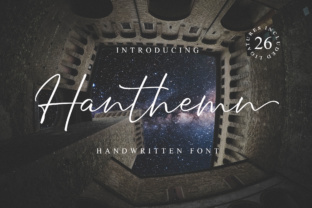
Redefining Elegance with Hanthen: A Comprehensive Guide to the Modern Script
In the rapidly evolving landscape of digital and print design, the search for a typeface that balances contemporary flair with timeless sophistication has never been more critical. While sans-serif fonts dominate corporate structures and serif fonts anchor traditional publishing, there exists a distinct niche where personality meets precision: the modern script. At the forefront of this movement is Hanthen, a versatile font that has quickly become a favorite among designers seeking to infuse their work with a touch of high-end class without sacrificing readability.
The design community often struggles to find scripts that do not feel overly decorative or archaic. Many traditional calligraphy fonts suffer from inconsistent stroke widths or poor legibility at smaller sizes, making them unsuitable for professional branding. Hanthen addresses these pain points directly. By merging the fluid motion of hand-lettering with the structural integrity required for commercial applications, it offers a solution that works seamlessly across photography portfolios, luxury packaging, and digital interfaces.
The Anatomy of a Modern Script
To understand why Hanthen stands out, one must look beyond its visual appeal and examine its technical construction. Unlike cursive styles that mimic the rapid, sometimes messy flow of a pen moving across paper, Hanthen is engineered with deliberate spacing and consistent weight distribution. This characteristic makes it an ideal choice for projects requiring clarity alongside style.
The font features smooth transitions between letters, creating a natural ligature effect that guides the eye effortlessly through a sentence. This flow is particularly effective in headlines and display text, where the goal is to capture attention immediately. However, unlike many scripts that degrade into illegibility when scaled down, Hanthen maintains its character even in smaller body copy contexts, provided the line height is adjusted appropriately.
- Fluidity: The strokes emulate the pressure of a brush or fine nib, offering organic variation without chaos.
- Consistency: The baseline alignment ensures that text blocks look neat and professional on any screen or page.
- Versatility: It bridges the gap between formal invitation typography and casual social media graphics.
Why Professionals Choose Hanthen
The adoption of Hanthen by professionals across various sectors is not accidental; it is a result of its ability to convey specific emotional cues. In branding, the font acts as a silent ambassador for the company's values. When a business owner selects Hanthen for their logo or marketing materials, they are signaling a commitment to quality, attention to detail, and a sophisticated aesthetic.
This versatility extends to the realm of photography. Photographers often struggle to find captions or overlays that complement their images without overpowering them. A heavy block font can clash with delicate light and shadow, while a standard sans-serif might feel too sterile. Hanthen strikes the perfect balance, adding a layer of artistic interpretation that enhances the mood of the photograph rather than distracting from it.
Practical Applications Across Industries
The utility of Hanthen extends far beyond simple decoration. Its adaptability allows it to serve as a functional tool in diverse workflows, from educational presentations to high-stakes legal documents that require a personal touch.
- Branding and Identity Systems: For startups and established businesses alike, a unique typographic voice is essential. Hanthen serves as an excellent primary font for logos, especially in industries like fashion, beauty, and hospitality. It pairs exceptionally well with clean geometric sans-serifs, creating a contrast that feels both modern and luxurious.
- Signature and Personal Branding: In an era of digital communication, a signature font adds authenticity. Whether used in email footers, eBooks, or certificates, Hanthen mimics the elegance of a handwritten signature. This subtle human element helps build trust and connection with the audience, making the sender appear more approachable and genuine.
- Event and Wedding Design: The classic association of script fonts with weddings remains strong, but Hanthen elevates this tradition. It is perfect for save-the-dates, menu cards, and signage. Its refined curves suggest romance and celebration, yet its structure ensures that vital information (dates, times, locations) remains easy to read for guests of all ages.
- Educational and Research Materials: Educators and researchers looking to make their slide decks or reports stand out can utilize Hanthen for section headers. It breaks the monotony of standard academic formatting, engaging students and readers who might otherwise skim over dense text.
Case Study: The Impact on Visual Hierarchy
Consider a scenario where a boutique hotel is rebranding its website. The previous design relied on a generic serif font that felt outdated. Upon switching to Hanthen for the main headings and navigation labels, the site immediately conveyed a sense of exclusivity and comfort. Users reported spending more time on the site, noting that the "feel" of the platform was more inviting. This demonstrates how a single typographic change can alter user perception and behavior significantly.
Integration and Workflow Considerations
Implementing Hanthen into a design workflow requires a strategic approach to ensure maximum impact. While the font is robust, like any tool, it demands respect and proper usage to avoid common pitfalls.
Pairing Strategies
The most successful designs using Hanthen rely on strong contrast. Because the script is busy and detailed, it should generally be paired with a neutral, low-contrast font for supporting text. A clean sans-serif like Helvetica or a sturdy slab serif provides a stable foundation that allows the Hanthen to shine as the focal point. Mixing two scripts is rarely advisable unless done with extreme caution, as it can lead to visual clutter.
Technical Optimization
For web developers, utilizing Hanthen involves ensuring proper font loading to prevent layout shifts. Using CSS variables to manage font weights and tracking is recommended. Additionally, because scripts can have varying letter widths, adjusting the letter-spacing property is crucial. Tight tracking can make the text look cramped, while loose tracking can break the flow of the words. Finding the sweet spot often requires iterative testing on different devices.
Future Trends in Typography
As we move further into a digital-first economy, the demand for personalized and expressive typography continues to grow. Consumers are increasingly tired of the "corporate flat" look that dominated the early 2010s. There is a resurgence of interest in human-centric design elements that remind users of the creative minds behind the products.
Hanthen aligns perfectly with this trend. It represents the intersection of technology and artistry. As AI tools begin to generate content at scale, the need for unique, human-like typography becomes even more valuable. Brands that adopt fonts like Hanthen differentiate themselves from competitors who rely solely on automated design templates.
Furthermore, the rise of mobile commerce necessitates fonts that are legible on small screens while maintaining their aesthetic integrity. Hanthen's modern construction ensures it scales effectively, making it a future-proof choice for responsive web design and app interfaces.
Expert Observations on Usage
Experienced designers often note that the success of a script font lies in restraint. The temptation to use Hanthen everywhere is strong given its beauty, but overuse dilutes its power. It is best employed as a spotlight, drawing the eye to key messages rather than serving as the background noise of a page. Whether it is underlining a price tag on a luxury product label or highlighting a quote in a blog post, the strategic placement of Hanthen creates moments of emphasis that resonate with the viewer.
Moreover, the cultural context matters. In Western markets, the flow of Hanthen feels familiar and elegant. However, for global brands, understanding the nuances of how the script interacts with different languages and reading directions is important. While primarily designed for Latin characters, its principles of fluidity can inspire cross-cultural design decisions that prioritize harmony and grace.
Conclusion: A Tool for Classy Design
In conclusion, Hanthen is more than just a font; it is a design philosophy that prioritizes elegance, readability, and modern relevance. It solves the age-old problem of finding a script that does not compromise professionalism for aesthetics. From photographers looking to add a signature touch to their portfolios to business owners crafting a memorable brand identity, Hanthen offers a reliable and stylish solution.
By understanding its characteristics and applying it with care, creators can elevate their work to new heights. The font serves as a testament to the enduring power of good typography in communicating value and emotion. As the design world continues to evolve, Hanthen remains a steadfast companion for those who seek to create lasting impressions through the written word.
Whether you are a hobbyist experimenting with custom invitations or a researcher presenting complex data, integrating Hanthen into your toolkit can transform ordinary text into an experience. It invites the reader to slow down, appreciate the form, and engage more deeply with the content. In a world of noise, Hanthen provides a clear, elegant signal of quality.